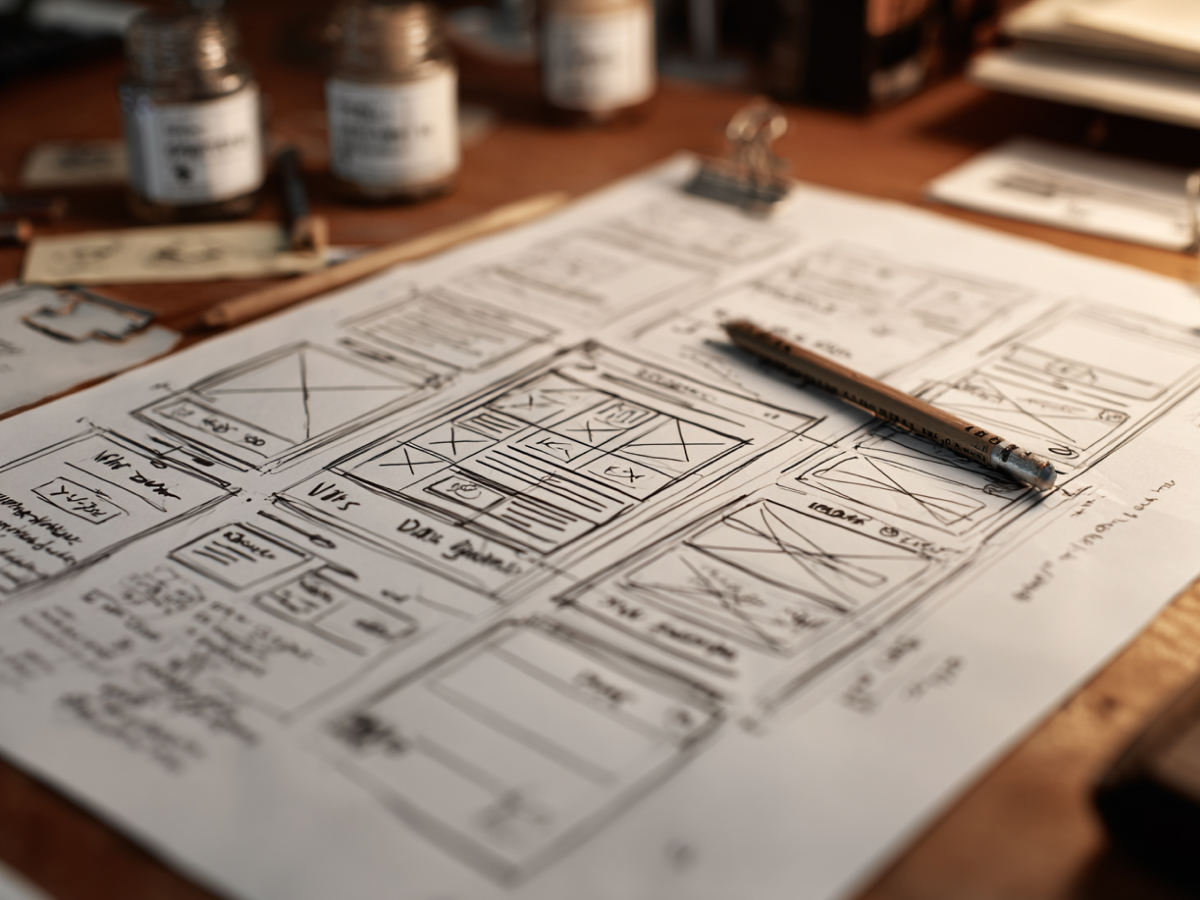
Prototyping aligns team and client understanding
When you’re creating something new, alignment is everything. A prototype is not a side exercise, it’s the first real test of collective understanding between your team and your client. It turns abstract ideas into something tangible, removing ambiguity and providing a clear visual of what the product will become. Instead of long debates over interpretation, everyone can see the same model and talk about real functionality.
For executives, this creates a decisive advantage. It shortens the feedback loop between vision and execution, ensuring that the development team is building what the market actually needs, not what internal documents interpret it to be. This early clarity reduces friction, accelerates key decision-making, and places the project on a foundation of mutual understanding.
In practical terms, a prototype acts as a shared reference point. It unifies conversation around a single version of the product’s core structure, its user experience, functionality, and value proposition. That shared vision is essential for reducing the disconnects that so often derail projects later in development. Decisions become sharper because every stakeholder is seeing the same data, design, and potential impact.
Rapid prototyping accelerates problem detection and fosters innovation
Speed matters. The faster your team can move from concept to validation, the quicker you can eliminate weak ideas and find what truly works. Rapid prototyping allows teams to test multiple solutions early, often within days or weeks instead of months. This process exposes technical or design flaws early, when they’re fast and cheap to fix.
Executives who focus on agility understand this: the sooner you identify a failing approach, the sooner you can redirect towards success. This approach doesn’t encourage carelessness; it drives disciplined experimentation. Teams become more resilient, creative, and strategic, operating under real-world conditions rather than theoretical assumptions. The “fail fast” concept is about building momentum, each iteration brings new clarity, fuels innovation, and enhances the quality of the final product.
Industry research supports this approach. The Project Management Institute reports that iterative development can reduce project overruns by up to 25%. That reduction translates directly into stronger efficiency and higher confidence in project timelines. For C-suite leaders, this means faster insights, smarter resource allocation, and a product development process that keeps pace with both technological evolution and market demand.
Rapid prototyping doesn’t just refine ideas, it builds organizational speed as a competitive advantage. It’s how companies learn faster, move faster, and stay ahead.

A project in mind?
Schedule a 30-minute meeting with us.
Senior experts helping you move faster across product, engineering, cloud & AI.
Prototyping reduces financial and operational risks through early evaluation
Prototyping isn’t just a creative step, it’s a financial safeguard. It allows a company to test assumptions before heavy investment. Executives understand that capital is best deployed when uncertainty is reduced, and that’s what prototyping achieves. By evaluating the feasibility and appeal of a concept early, businesses can see which ideas have real traction and which do not.
The process also uncovers the technical and market challenges that could escalate costs if discovered later. Catching these early prevents wasted development cycles and keeps spending predictable. For companies that operate with high R&D budgets or long development timelines, this discipline in evaluation matters significantly. It means resources are directed toward concepts that demonstrate evidence of success, not ideas based on internal enthusiasm alone.
Research supports this approach. The Harvard Business Review has reported that early-stage prototyping can lower product development costs by addressing issues before they become systemic. For C-suite leaders, this translates into leaner operations, lower risk exposure, and stronger investor confidence. Instead of putting large sums behind uncertain outcomes, leadership can make data-informed decisions with defined performance evidence from the prototype phase.
More than saving money, effective prototyping sharpens decision-making. It provides factual clarity on whether a product can meet its technical, user, and market goals, long before scaling becomes expensive. This level of foresight turns a potentially risky investment into a calculated, manageable step forward.
Prototyping helps prioritize essential features and eliminate unnecessary complexity
In every product, focus determines quality. Prototyping guides teams to identify what truly adds value to the user experience and what doesn’t. Each iteration offers a chance to simplify and eliminate distractions, leaving only features that directly support the product’s function and business objectives. For executives, this creates a sharper product narrative, where every element serves a purpose and every resource is used efficiently.
This constant refinement ensures strategic alignment. Teams can test features systematically, discarding what fails to enhance usability or competitive differentiation. It’s not only a design choice, it’s an operational principle that sustains efficiency throughout the organization. When teams maintain clarity on priorities, they spend less effort on low-impact work and more on elements that define long-term success.
Industry benchmarks often confirm the value of this discipline. Iterative testing and feature prioritization have been linked to up to a 40% improvement in user satisfaction and measurable gains in engagement metrics. For decision-makers, that’s not an abstract improvement; it’s a performance outcome tied to market reception and profitability.
When complexity is reduced, the product becomes easier to scale, update, and position in the market. The focus remains on delivering what customers actually need, supported by a process that rewards simplicity, efficiency, and precision. This clarity drives faster execution and stronger results, both essential for leadership teams aiming to sustain growth in a fast-moving digital economy.
User feedback during prototyping ensures user-centered product design
User input gives direction early, when the product can still change easily. Prototyping creates a structured way to test usability, gather real reactions, and refine based on facts instead of assumptions. Small-scale user testing exposes interaction flaws, feature gaps, or unclear interfaces before release. When teams make these corrections early, they save both cost and time while improving overall product quality.
For C-suite executives, this process means decisions are guided by data from real users, not internal opinions or market projections. It anchors development in measurable feedback and aligns the product with the habits and needs of its target audience. With this early validation, leaders can move forward with stronger conviction, knowing that the product’s key design and functionality decisions already hold up in front of actual users.
Research from UX testing studies shows that collecting feedback at the prototype stage can reduce time-to-market by up to 20%. This gain comes from lower rework rates and smoother transitions into later development phases. For senior leaders, that time advantage translates to market responsiveness and higher ROI, especially in competitive environments where speed and user satisfaction determine market share.
Continuous testing during prototyping also builds long-term user trust. When companies involve their audience early, they demonstrate a commitment to genuine improvement, not just feature delivery. That approach strengthens brand integrity and positions the business as adaptive, data-driven, and focused on real-world performance.
Prototyping establishes a strong foundation for product development
Every successful product begins with clarity, technical, financial, and strategic. Prototyping provides that clarity by testing the interaction between the idea, the technology, and the market before large-scale build-out begins. This stage acts as a checkpoint, aligning teams around verified insights rather than untested ambition. For company leaders, that alignment sets the tone for efficient execution and predictable progress.
Through prototypes, organizations collect tangible evidence about performance, usability, and business feasibility. Each iteration strengthens the decision-making base, making downstream processes, such as design finalization, budgeting, and market rollout, more reliable. Projects that start with a strong prototype phase often move faster through later stages because most uncertainties have already been handled.
Although the article includes no specific research citation, data from agile and lean product development studies consistently show that structured prototyping improves delivery efficiency and resource allocation. For executives, this means lower operational risk and a higher probability of market success, achieved through informed planning rather than reactive adjustments.
Prototyping, when integrated into company culture, becomes more than a step in the process, it becomes a method of thinking. It brings transparency, speed, and accuracy to strategic execution. This disciplined approach ensures that vision and practicality develop together, producing results that are not just innovative but also sustainable and market-ready.
Key highlights
- Align vision early: Use prototyping to create a shared understanding between teams and clients. Leaders should encourage visual alignment early to prevent costly miscommunication and ensure product clarity from the start.
- Accelerate problem-solving: Rapid prototyping helps teams identify flaws and validate solutions quickly. Executives should promote fast iteration cycles to reduce project overruns and foster innovation.
- Control financial risk: Prototyping allows early validation of technical and market feasibility before major investments. Leaders should use it to allocate resources strategically and lower exposure to uncertain outcomes.
- Focus on what matters: Iterative prototyping exposes unnecessary complexity and highlights essential features. Decision-makers should drive teams to prioritize high-impact elements that strengthen usability and align with business goals.
- Design with users: Real user feedback during prototyping ensures products meet actual needs. Executives should make early user testing a standard part of development to boost satisfaction and speed market readiness.
- Build from a tested foundation: Prototyping provides a structured base integrating technical, financial, and market insights. Leaders should embed it as a core process to improve planning accuracy, execution speed, and long-term product success.

A project in mind?
Schedule a 30-minute meeting with us.
Senior experts helping you move faster across product, engineering, cloud & AI.