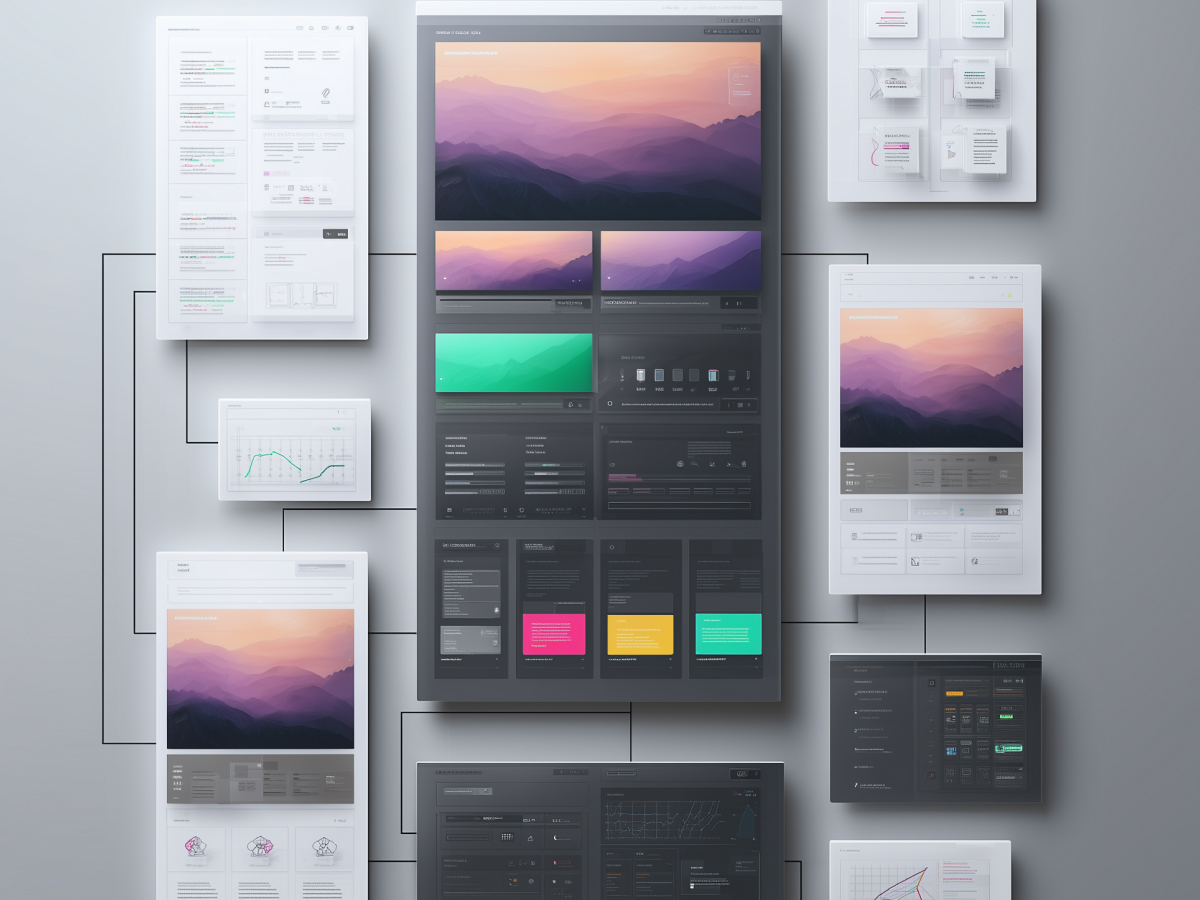
Establish strong visual foundations
A strong visual foundation is the backbone of any design system that actually gets used. Before you start defining components or governance models, build the core visual elements, color, typography, and spacing, that create consistent language across all interfaces. These are not optional details; they are the framework that everything else depends on. At Netguru, teams found that skipping this stage leads directly to low adoption and a fragmented user experience.
Start with color. Define a complete numeric color scale, assigning primary hues baseline values and incrementing tones numerically, say, from 50 for the lightest tint to 900 for the darkest shade. Material Design and Tailwind use this system because it removes ambiguity and prepares teams for scalability, including dark mode. Add semantic meaning as early as possible, for instance, red for errors and green for confirmations, to reduce interpretation errors across teams. Accessibility should be integrated from day one. Ensure your core color combinations meet AA or AAA contrast standards to make interfaces readable and inclusive.
Typography defines structure and guides the rhythm of communication. A well-defined type scale, based on hierarchy and functional purpose, creates visual harmony. Keep the range simple but purpose-driven, covering headlines, body text, subtitles, captions, and buttons. Material Design’s 13-style type scale sets an achievable standard, combining flexibility with consistency. Define font families, sizes, weights, and spacing to make the system universal across devices and screen sizes.
Finally, control spatial rhythm. Grid systems and spacing rules bring order to interfaces. Use an 8px base unit, it’s reliable, repeatable, and industry-standard. Carbon’s spacing model, ranging from 2px to 160px, introduces small increments for detail-level work and large increments for macro layout control. With these foundations locked in, you guarantee consistency and clarity across products, no matter how complex they become.
Leverage design tokens for system-wide consistency
Design tokens turn theoretical design systems into working infrastructure. A token is a variable that stores design values, color, typography, spacing, component detail, so that teams can implement consistent visual styles without redefining them in multiple places. They’re stored centrally, platform-agnostic, and readable by both designers and developers.
When you define tokens, you’re building a central database for your design language. Updating a color, for example, doesn’t require editing hundreds of files, it requires changing one token. Those values instantly sync everywhere, from code to design prototypes. This not only saves time but also ensures your users experience the same interface quality across every platform and device.
Tokens also drive stronger collaboration. Developers don’t need to guess design intent, and designers get predictable execution. It eliminates redundancy and miscommunication, increasing development velocity. This consistency shortens feedback loops, accelerates iteration, and dramatically reduces the burden on QA teams checking for visual inconsistencies.
For business leaders, tokens are an efficiency multiplier. They create a scalable framework that lowers design debt and future-proof products against brand or UI evolution. When global design updates can cascade automatically across tools and codebases, teams deliver faster without eroding quality. It also turns brand consistency from an aspirational goal into a guaranteed outcome. In financial terms, tokens represent operational leverage, they let teams scale quality exponentially without scaling cost.
Conduct a comprehensive audit and prioritization of components
A design system only becomes valuable once it reflects the true scope of your product ecosystem. That begins with a full audit of your existing components. Capture screenshots of every live interface, not just design files, to expose inconsistencies in real product environments. Group components by type, such as buttons, inputs, modals, and forms, to identify duplicates and variants. This process gives you a full map of your product’s visual and functional behavior. It’s detailed work, but it gives stakeholders proof of fragmentation and the scale of the challenge ahead.
Once visibility is established, prioritize which components to address first. Focus on ones that deliver the highest value, elements with the greatest usage frequency across your platform. Buttons, input fields, and navigation components usually lead because they define core interactions for users. Next, consider complexity, standardizing elements that require recurring complex development offers strong ROI. Finally, weigh impact, components linked to accessibility or primary workflows deserve immediate attention because they influence both brand reliability and user satisfaction.
For leadership, the audit stage reveals the hidden inefficiencies in design and engineering pipelines. It builds a clear business case for systematization by identifying where repeated manual work is undermining speed and consistency. This visibility strengthens investment decisions because leaders can now connect design fragmentation directly to operational cost. Once you have structured component priorities, you can budget resources intelligently, allocating time to high-value areas and reducing waste in less relevant ones.
Develop structured documentation templates
After auditing and prioritizing, documentation becomes the mechanism that translates design intent into repeatable action. Without structure, different contributors produce inconsistent, unusable outputs. Establish templates upfront that standardize how information is recorded and presented. Each document should include key fields, component name, visual references, behaviors, edge cases, usage rules, and associated code snippets. Templates save time because team members don’t need to guess the preferred format for each component or rewrite documentation from scratch.
Templates also make updates and onboarding simpler. New contributors can understand the system faster, and existing team members maintain consistency with minimal instruction. Define guidelines for tone, length, terminology, and labeling conventions early to ensure uniformity. Consistent structure avoids ambiguity, keeps your documentation system scalable, and ensures that content remains intelligible even as the product grows.
For executives, structured documentation represents operational clarity and risk control. It reduces dependency on individual contributors by codifying institutional knowledge. This has measurable impact: onboarding times shrink, the margin for error drops, and every new feature development starts from validated patterns. Documentation excellence converts design assets into durable business assets, reducing overhead and preserving quality during rapid scaling.
Establish centralized access and governance with clear ownership
A design system only works if it’s universally accessible and systematically managed. Every team should be able to access the same files, assets, and documentation without delays or permission barriers. Centralizing design repositories ensures everyone operates from a single, current version. This helps avoid inconsistencies and enforces alignment across design, development, and product functions.
Governance determines whether the system thrives or collapses. Assign clear roles: a Champion to secure executive support and resources, a Product Owner to drive strategy and execution, and a Design Library Owner or Maintainer to curate, review, and publish updates. Define a formal contribution process where teams consult existing components before proposing new ones. Ensure modifications follow structured UX reviews, development testing, and documentation updates before release. This creates accountability and protects quality across all contributions.
Different governance models work for different organizations. A centralized model works best for teams requiring strict standardization, led by a dedicated DesignOps team. A federated model empowers distributed teams to contribute while maintaining a degree of local autonomy. Regardless of approach, what matters is transparent ownership and defined processes for decision-making, implementation, and communication.
For executives, governance is about safeguarding consistency and ensuring strategic alignment. When ownership, access, and contribution boundaries are clear, the design system scales efficiently without internal conflict. It minimizes duplicated work, resolves dependency bottlenecks, and locks brand execution to defined standards. Good governance also protects investments, turning the design system into sustainable intellectual property rather than an informal collection of design files.
Implement robust file management, version control, and backup systems
As a design system evolves, growth brings complexity. Effective file management keeps that complexity under control. Start by implementing structured naming conventions that describe the file’s contents and purpose. Standardized folder hierarchies must be documented and accessible, allowing quick retrieval of the correct resources. Establishing these norms early reduces confusion and ensures long-term system stability.
Version control provides transparency and confidence when rolling out updates. Adopt semantic versioning to communicate the impact of each change, major versions for breaking updates, minor versions for feature additions, and patch versions for bug fixes. This clarity helps every team understand when adjustments are necessary and prevents unintentional disruptions in dependent systems. Alongside this, set up an automatic backup system to secure version history and prevent data loss. Losing design assets isn’t just inconvenient, it resets progress and wastes development time. A reliable backup structure prevents that risk.
For C-suite leaders, strong file management and version control represent operational discipline and accountability. They reduce time wasted on searching for assets or backtracking across iterations, allowing teams to focus on outcome delivery. Executives benefit from version control because it enables transparent change tracking and predictable release cycles, two essential traits when coordinating design work across global teams. Robust backup systems also protect intellectual property and assure business continuity, reinforcing confidence that work remains durable regardless of system failures or personnel changes.
Utilize effective project tracking and communication frameworks
A design system needs operational rhythm to stay active and relevant. That rhythm comes from disciplined tracking and clear communication. Use tools such as Jira or Google Sheets integrations to monitor work progress, manage dependencies, and visualize goals against execution. These platforms allow real-time reporting and visibility across multiple teams and ongoing projects. A structured tracking framework ensures that everyone knows what’s in progress, what’s blocked, and what’s next in the release cycle.
Short, daily standup meetings, around 10 to 15 minutes, should be a fixed part of project routines. Each participant shares what they accomplished, what they plan to do next, and what obstacles require attention. Bringing these updates into daily visibility prevents blockers from accumulating and signals early warning when a process slows down. Every update, change request, or new feature added to the system must be documented in a visible changelog. This record keeps everyone informed about the latest additions or modifications. Sharing changelogs through tools such as Figma, Slack, or internal portals maintains alignment organization-wide.
Sustained transparency also requires strong communication channels. Keep weekly open office hours for questions and feedback, and maintain dedicated channels for updates and troubleshooting. Provide onboarding sessions for new team members to introduce them to your system’s workflow and governance. The goal is to make information flow continuous, everyone stays informed, and accountability remains shared.
For executives, tracking and communication frameworks represent the operational infrastructure that keeps innovation consistent. They enable a teams-wide understanding of progress and bottlenecks and prevent misalignment between departments. Leaders can use this transparency to assess efficiency, identify recurring constraints, and make evidence-based resource decisions. Teams that communicate openly and monitor effectively maintain higher velocity and fewer redundancies, ensuring every innovation cycle operates on time and within scope.
Embrace continuous iteration and adaptation
A design system is not a one-time project. It is a living structure that evolves as products, technologies, and customer expectations evolve. Start with manageable, high-impact components that deliver visible value, buttons, input fields, navigation patterns, and use these quick wins to demonstrate the system’s effectiveness. As your team gains confidence and adoption increases, expand to more complex and less frequent components. This iterative method ensures early results while maintaining steady growth.
Iteration means revisiting components as design standards, accessibility requirements, or brand strategies shift. Feedback from stakeholders and end users should feed directly into the update cycle, ensuring that the system remains valid and relevant. Establish a predictable review cadence that captures these updates, aligns them with organizational goals, and documents their impact on product consistency and performance. This continuous adaptation keeps the design system functional long after its initial implementation.
For C-suite executives, iteration is a sign of organizational maturity. It reflects a company’s capability to evolve quickly and maintain design coherence across transformations. An adaptive design system reduces rework, supports product scalability, and enforces alignment between brand strategy and customer experience. Leaders who champion continuous iteration set up their organizations for lasting efficiency, because updates become routine progress rather than crisis-driven fixes. It’s both a creative and operational discipline, ensuring the design system stays at the center of innovation.
Concluding thoughts
A strong design system isn’t a set of files, it’s an operating model for speed, quality, and brand integrity. The companies that treat it this way outperform those that see it as a design-only initiative. When clarity, structure, and governance come together, you create a single system that cuts waste and compounds value with every release.
For executives, this is about measurable impact. A centralized, well-managed design system shortens delivery cycles, aligns products globally, and scales creativity without chaos. It turns brand consistency into a growth engine, not an afterthought. The success factor isn’t the number of components you build, it’s how effectively those components connect your teams, processes, and users around a unified purpose.
Keep it simple, documented, and evolving. A design system built on these principles doesn’t just support your products, it strengthens your organization’s capacity to move faster with precision, confidence, and shared vision.


A project in mind?
Schedule a 30-minute meeting with us.
Senior experts helping you move faster across product, engineering, cloud & AI.